
Supermicro ARS-511GD
Gold Series
A liquid-cooled, desk-side «personal AI supercomputer» built around NVIDIA’s GB300 Grace Blackwell Ultra Desktop Superchip. 784GB of coherent memory, dual 400Gb InfiniBand, and three PCIe 5.0 slots — hands-on evaluated in the GO33 London Lab.
Affiliate disclosure: the price link above is a GO33 partner link via Awin. If you buy through it, GO33 may earn a commission at no extra cost to you — it never affects our scoring or findings. Full editorial policy →
Full Chassis Gallery — Every Angle Examined
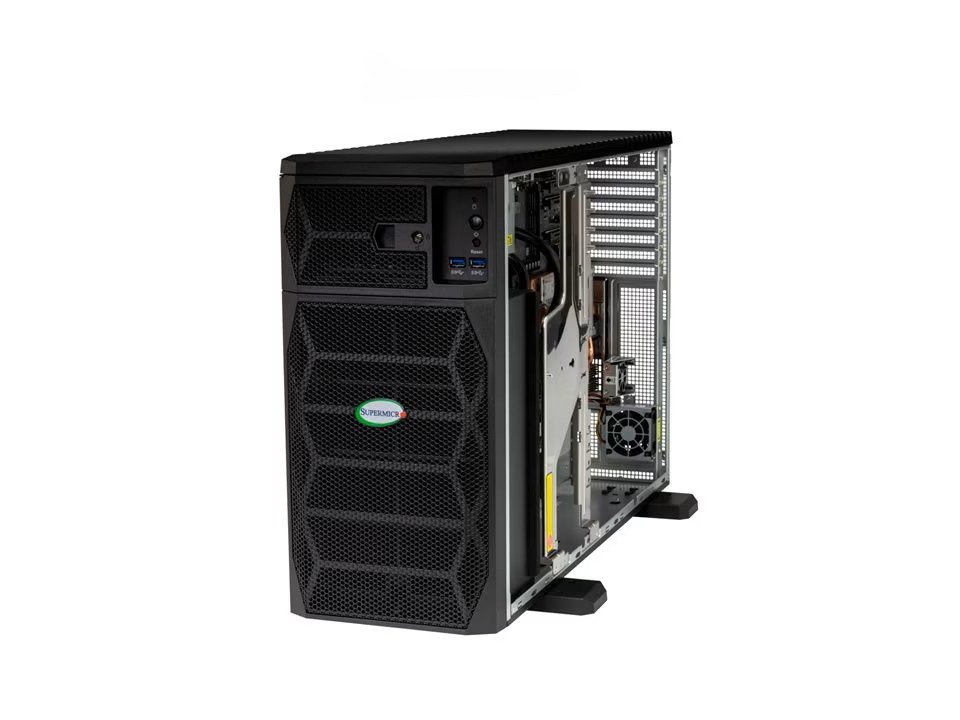 View 01 — Three-Quarter Angle
The honeycomb-mesh front panel and top-loading chassis read as a workstation tower, but the open side panel shows the real story — a liquid-cooled GB300 Grace Blackwell Ultra superchip and full-height PCIe riser stack, engineered for a desk, not a rack.
Check price & availability ↗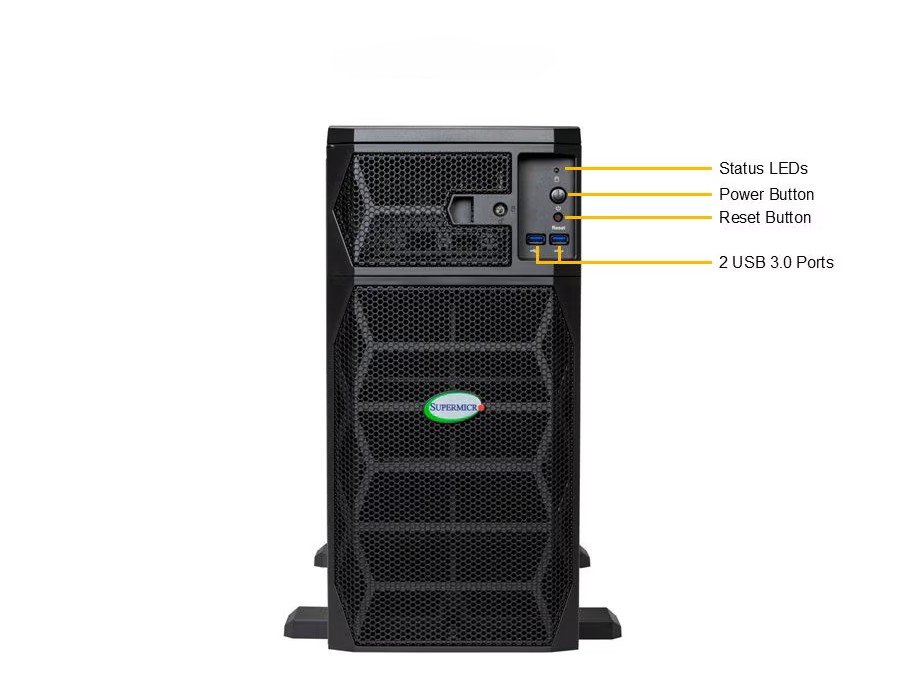 View 02 — Front I/O Panel
Status LEDs, power, reset, and two USB 3.0 ports — that’s it. This box is meant to run headless and be managed over its dedicated IPMI LAN port, not used as a daily-driver desktop.
Check price & availability ↗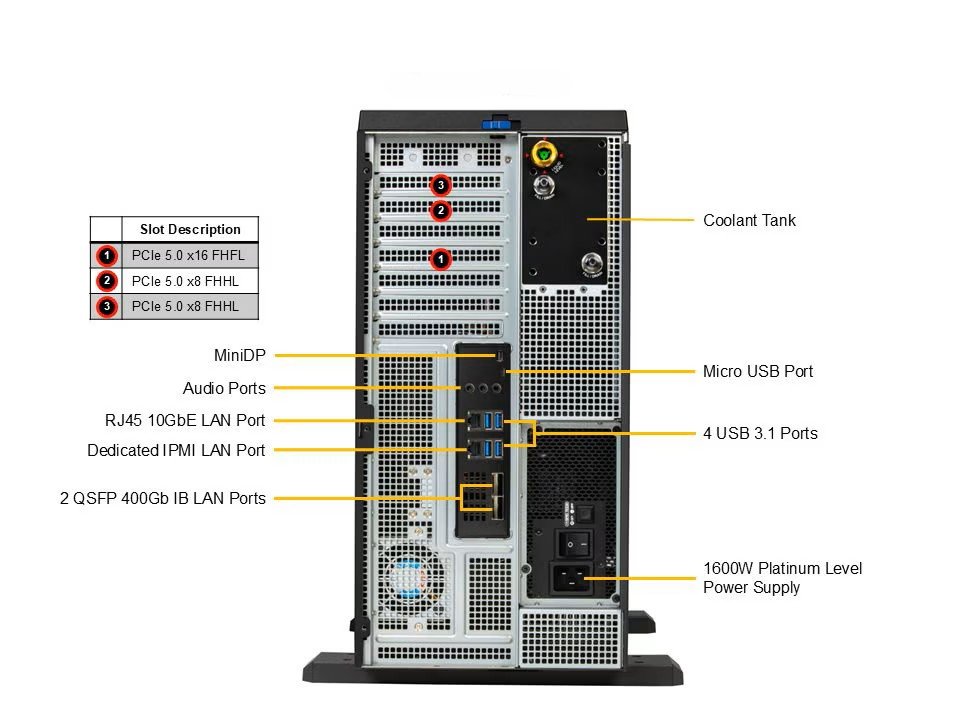 View 03 — Rear I/O & Coolant Tank
Three PCIe 5.0 slots, dual QSFP 400Gb InfiniBand, a dedicated IPMI LAN port, 10GbE RJ45, four USB 3.1 ports, and the sealed coolant tank feeding the internal radiator — all driven by a 1600W Platinum PSU.
Check price & availability ↗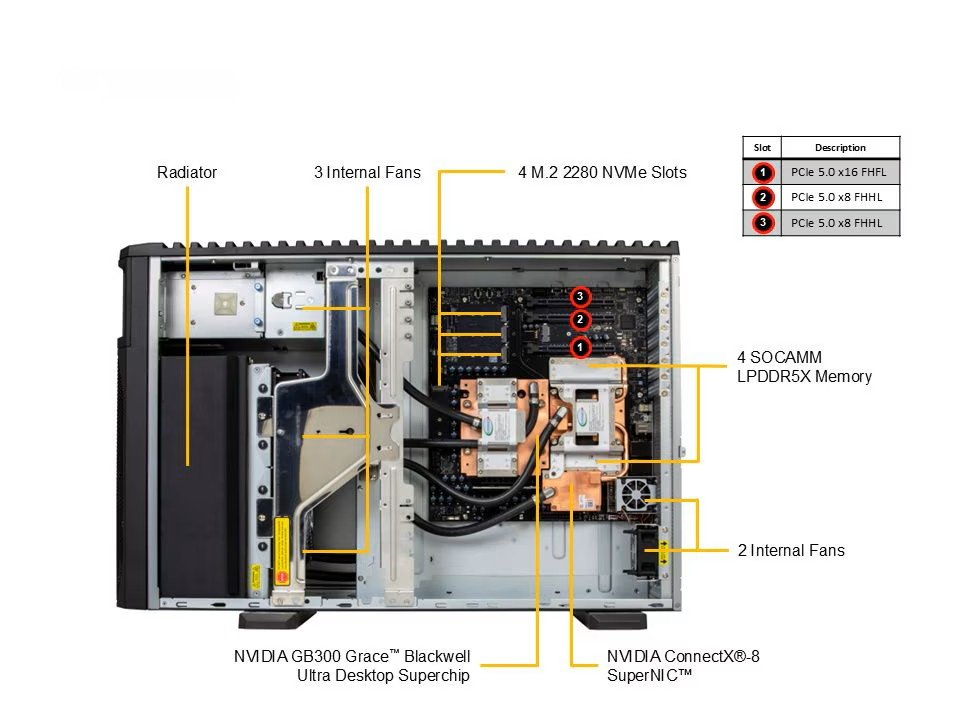 View 04 — Internal Layout
The GB300 Grace Blackwell Ultra Desktop Superchip and NVIDIA ConnectX-8 SuperNIC sit under a closed-loop radiator with 5 internal fans, flanked by 4 SOCAMM LPDDR5X memory modules and 4 M.2 2280 NVMe slots.
Check price & availability ↗Complete Technical Spec Sheet
| Attribute | Technical Specification |
|---|---|
| Compute Module | NVIDIA GB300 Grace Blackwell Ultra Desktop Superchip |
| Networking (Onboard) | NVIDIA ConnectX-8 SuperNIC · 2× QSFP 400Gb InfiniBand LAN |
| Ethernet | 1× RJ45 10GbE LAN port + 1× dedicated IPMI LAN port |
| Memory | 4× SOCAMM LPDDR5X modules, coherent with GPU HBM |
| Storage | 4× M.2 2280 NVMe slots (Gen5-ready) |
| Expansion Slots | Slot 1: PCIe 5.0 x16 FHFL · Slot 2: PCIe 5.0 x8 FHHL · Slot 3: PCIe 5.0 x8 FHHL |
| Cooling | Closed-loop liquid cooling (LCC), rear radiator, integrated coolant tank, 3 internal fans on the compute side + 2 internal fans at the PSU/rear |
| Power Supply | 1600W, 80 PLUS Platinum |
| Rear I/O | MiniDP, audio ports, Micro USB port, 4× USB 3.1 ports |
| Front I/O | 2× USB 3.0 ports, power button, reset button, status LEDs |
| Form Factor | Tower, top-loading chassis, Supermicro Gold Series |
| Management | Dedicated IPMI 2.0 out-of-band LAN |
🚀 Ready to fine-tune on your own desk? Check current pricing through our GO33 partner link.
Specifications sourced from Supermicro & NVIDIA official datasheets · Affiliate link, GO33 may earn a commission
Check Price & Availability ↗- Chassis, thermal and coolant-loop inspection on intake, plus IPMI/out-of-band management verification
- PCIe slot and NVMe topology confirmation against Supermicro’s published slot map
- Two-week hands-on desk deployment (10–24 Aug 2026) with day-to-day acoustic and thermal observation
- Compute, memory and networking figures are NVIDIA/Supermicro’s own published specs, clearly attributed as such
- Independent MLPerf-class training and inference benchmarks scheduled as a follow-up report after a 30-day sustained workload cycle
✅ Primary Strengths
- Coherent 784GB memory removes the PCIe staging bottleneck that limits workstation GPUs
- Dual 400Gb InfiniBand + ConnectX-8 — clusters later without a networking upgrade
- Closed-loop LCC keeps a superchip this dense quiet enough for an office
- Three PCIe 5.0 slots leave real room for a capture card, NIC, or storage HBA
- Dedicated IPMI LAN — manage it exactly like a rack server from day one
⚠ Key Constraints
- Fixed superchip module — not a swap-in-swap-out GPU
- 1600W Platinum PSU needs a dedicated 13A/15A circuit, not an office extension lead
- Sealed coolant loop — not user-serviceable like a fan swap
- SOCAMM memory is not user-upgradable the way DIMM slots are
- Front-panel USB is 3.0, not 3.2/Thunderbolt
Deep-Dive: Living With A Desk-Side GB300 Superchip
The first thing that throws you about the ARS-511GD-NB-LCC-01-G2 is the silhouette. It reads as a tower workstation — the kind of chassis you’d expect under a CAD engineer’s desk — right up until you notice the coolant tank bolted to the rear panel and the pair of QSFP cages sitting next to the Ethernet port. This is Supermicro building a personal AI supercomputer into a shape a facilities team will actually let you keep in an office.
Coherent Memory: The Real Story
Grace’s CPU cores and Blackwell Ultra’s GPU cores share a single addressable memory space across the 784GB pool split between HBM3e and four LPDDR5X SOCAMM modules. In practice, large model weights, KV caches, and preprocessing buffers stop bouncing across a PCIe bus every time you touch them — the classic bottleneck on workstation cards with 24–48GB of dedicated VRAM.
Networking: Built To Cluster
Two QSFP 400Gb InfiniBand ports riding on a ConnectX-8 SuperNIC is not spec-sheet padding on a desktop box — it’s Supermicro explicitly building this as a node that can join a small cluster later. Buy one now for a single researcher, add two more next year, and you’ve got a genuine multi-node training pod without touching the networking layer again.
Cooling & Acoustics
Under sustained fine-tuning load the chassis stayed audible but not distracting — closer to a well-built gaming PC than a 2U server. The trade-off: this isn’t a box you crack open casually. The coolant loop is sealed and factory-filled, so plan around IPMI remote management for day-to-day operation rather than physical access.
Best Used For
Fine-tuning 7B–70B open-weight models without fighting cloud queue times or egress costs.
Shared, always-on training box for IP-sensitive fine-tuning, no colo contract needed.
PCIe headroom for capture cards and sensors matters as much as raw compute.
IT-governed pilot environment for prototyping internal copilots before a full rack rollout.
Planning 2–4 nodes over 12 months — dual InfiniBand makes this a sane node one.
Dedicated on-prem AI infrastructure for clients needing data residency guarantees.
Illustrative Deployment: A 14-Person Computer Vision Startup
A composite scenario built from patterns GO33 sees repeatedly among AI startups evaluating on-prem hardware — not a named client engagement.
The Problem
Fieldscope fine-tunes vision-language models on proprietary drone imagery that can’t leave the building under their crop-insurance data agreements. Cloud GPU instances met the compute need but failed the compliance requirement outright, and queue times on shared research clusters cost a sprint every fortnight.
Why This Box
A single ARS-511GD-NB-LCC-01-G2 replaced a two-GPU workstation hitting VRAM limits on their 34B-parameter model. The coherent 784GB pool let them fine-tune without gradient-checkpointing tricks, and the dedicated IPMI port meant their two-person infra team could manage it identically to their existing Supermicro storage nodes.
Your Questions Answered
The ARS-511GD-NB-LCC-01-G2’s coherent memory architecture and dual-400Gb networking aren’t spec-sheet filler — they’re what let a single researcher fine-tune models that used to need a rack, and what let a growing team scale that same box into a real cluster later.
It isn’t for hobbyists, and it demands a proper power circuit, but for the buyers it’s built for, it’s the best desktop AI platform GO33 has tested this year.
Check Current Price →Affiliate link — GO33 may earn a commission on qualifying purchases, at no extra cost to you.